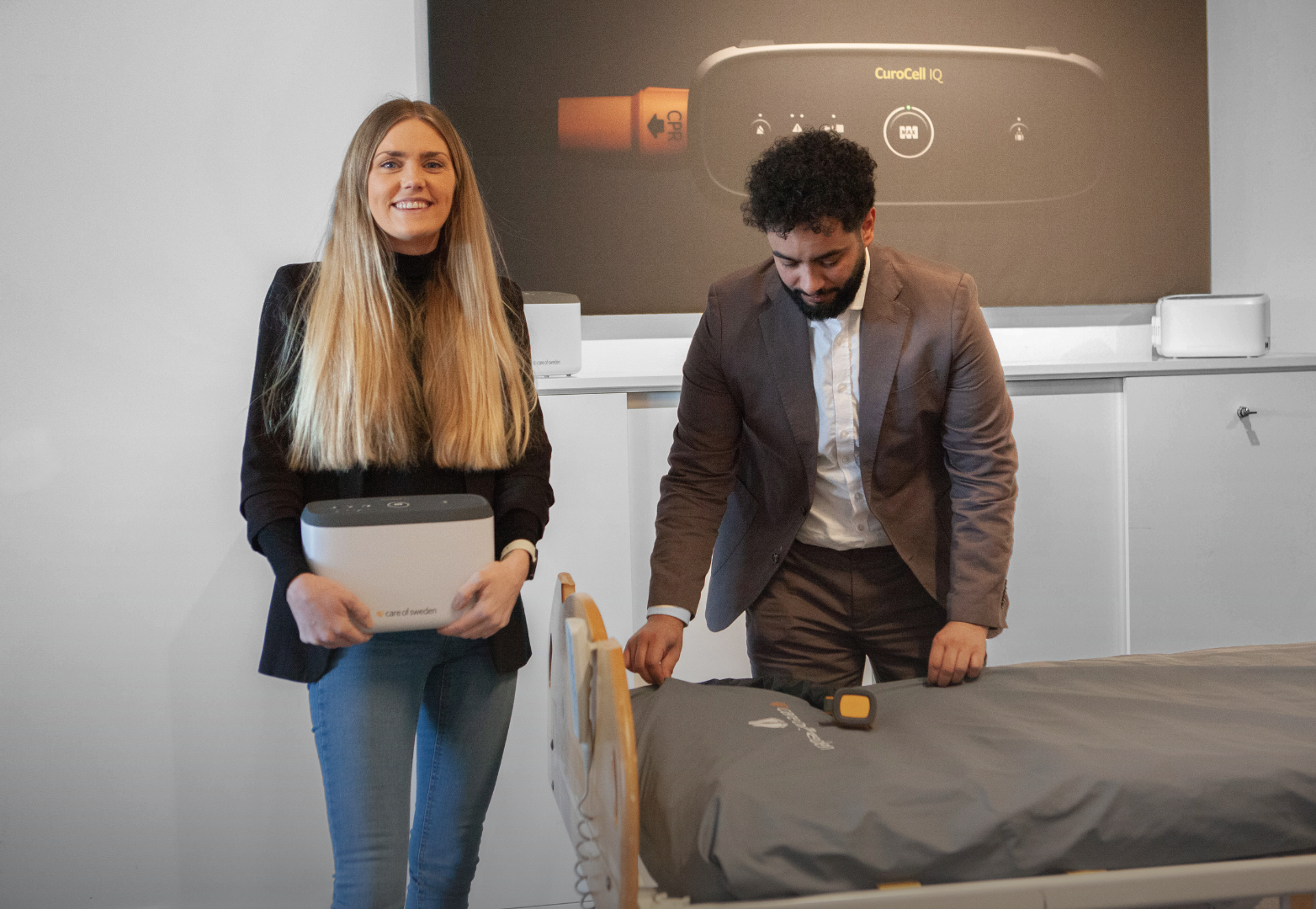
Autonomous Technology Can Save Money in Healthcare
An ageing population, staff shortages and financial pressure make preventive work in healthcare more challenging. Pressure injuries cause significant suffering and high costs – but according to Magnus Högberg, many of them can be avoided.
– “The key lies in autonomous solutions that prevent pressure ulcers while simultaneously relieving the burden on healthcare professionals.”
Healthcare is facing several structural challenges. The number of elderly patients – many with complex needs – is increasing rapidly, while staffing resources are insufficient. According to Magnus Högberg, CEO and founder of Care of Sweden, new ways of working and technologies that can take greater responsibility in daily care are therefore required.

– “Today’s healthcare systems are organized for a completely different demographic reality. When more elderly patients require advanced care at the same time as resources are limited, it becomes increasingly difficult to work preventively and sustainably. This is where autonomous technology can play a crucial role,” he says.
The mission: preventing suffering
Care of Sweden develops and manufactures medical technology solutions to prevent and treat pressure injuries. The goal is to help healthcare providers work more proactively by strengthening patient safety and making care more sustainable.
– “When technology takes over parts of the workload, time is freed up for healthcare staff and patients receive better protection. Demographic changes make this issue increasingly urgent. More elderly patients are at higher risk of pressure injuries, while staff are expected to care for more patients. This creates a need for solutions that work more independently, without requiring continuous manual intervention.”
Innovation that works in practice
According to Fares Al‑Khaliliy, Clinical Manager, technology alone is not enough to prevent pressure injuries. Care of Sweden’s solutions are developed in close collaboration with healthcare professionals and are based on clinical evidence.
He explains that much of today’s care relies on staff continuously monitoring, adjusting and responding – an approach that may work in theory, but in a pressured clinical environment can lead to variation, where interventions sometimes occur too late or not at all.
– “When technology can take greater responsibility for continuous adjustment, that dynamic changes. Care becomes more stable and predictable.
Studies show that a large proportion of pressure ulcers can be prevented with the right support surfaces and a systematic approach, while treatment is often significantly more costly than prevention. Evaluations also show that manually adjusted mattress systems require repeated checks and that incorrect settings are common.”*
Many products currently available on the market require ongoing supervision and manual checks – minutes that over time add up to many hours per patient.
– “Autonomous solutions can therefore relieve the burden on healthcare; when systems adapt individually, the need for continuous monitoring and manual adjustments decreases, freeing up time and improving comfort for both staff and patients. The difference lies not in the existence of technology, but in whether it has been clinically evaluated in the environment where it is used. Only then can it be shown to work in practice.”
Procurement that drives change
Angelica Mänd, Chief Commercial Officer, explains that EU‑based production – so‑called Made in EU – is an important part of the company’s strategy, both in terms of quality and supply reliability.
At the same time, she believes that healthcare procurement processes need to adopt a longer‑term perspective, where not only purchase price but also total cost of ownership, workload, and real patient outcomes are considered. Otherwise, solutions that prevent complications, reduce manual handling and deliver better long‑term results risk being disadvantaged.
– “Procurement is one of healthcare’s most powerful steering mechanisms. If it only rewards the lowest price, costs risk being shifted further down the care chain, leading to increased staffing needs, more complications, and higher overall costs. When quality, clinical effectiveness and long‑term economics are c onsidered, the picture changes. Preventive solutions can reduce manual interventions, ease the workload for staff, and contribute to better patient outcomes.”
For Care of Sweden, the future of healthcare lies in combining evidence, innovation and smart governance.
– “When technology, research and decision‑making pull in the same direction, we can both prevent suffering and make healthcare more sustainable,” concludes Magnus Högberg.
*Source: Ward C. Journal of Tissue Viability, 2010.